

The CSRD report corresponds to the sustainability declaration introduced by the Corporate Sustainability Reporting Directive (CSRD). Integrated into the management report, it aims to standardize ESG reporting by European companies through a common framework based on the European Sustainability Reporting Standards (ESRS).
Unlike previous non-financial reporting formats, the CSRD requires a much more structured approach, based in particular on double materiality analysis, the identification of impacts, risks and opportunities (IROs), and the publication of detailed, auditable ESG indicators.
In concrete terms, a CSRD report must make it possible to understand :
- the company's sustainability strategy,
- material ESG issues identified,
- policies and action plans deployed,
- indicators monitored,
- transition objectives,
- as well as the associated governance and control systems
What does a CSRD report look like?
The model presented below is an example of an anonymized ESG report inspired by a real-life case. It illustrates the structure of ESG reporting in line with ESRS standards: governance, double materiality, sustainability strategy, ESG indicators and environmental, social and governance information.
Download the complete CSRD report template to see how a CSRD-compliant sustainability statement should be organized.
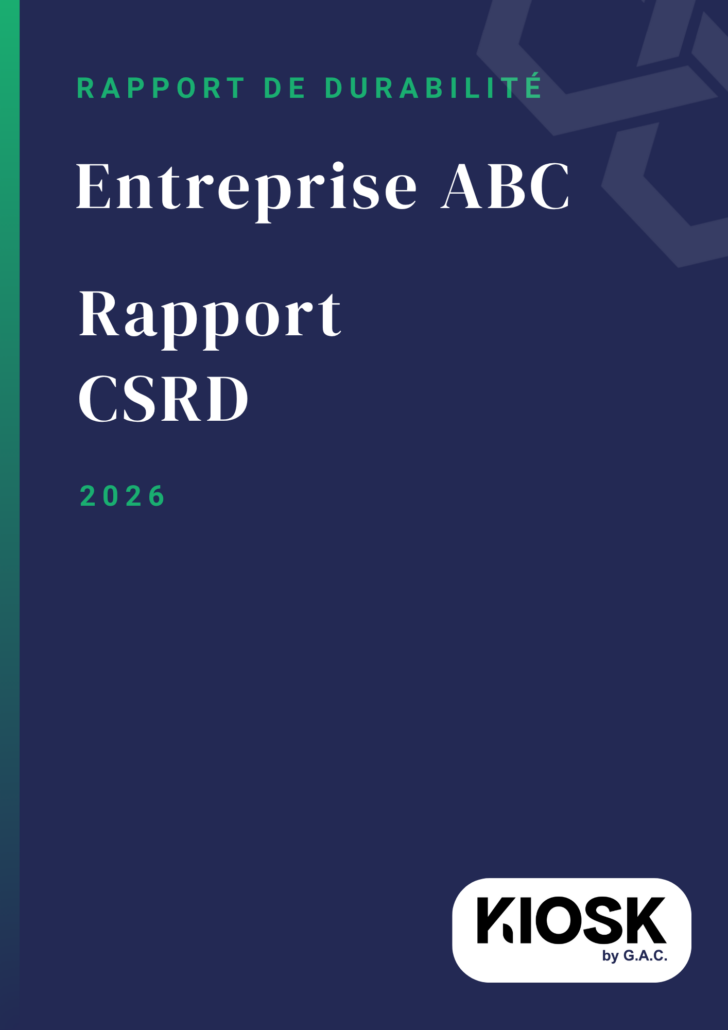
CSRD report template (anonymized example)
This CSRD reporting template covers the main sections expected in an ESRS-compliant sustainability statement. It illustrates how companies can structure their ESG reporting around governance, strategy, double materiality analysis and environmental, social and governance information.
Structure of a CSRD report
Consolidation scope, reporting period, reference framework used, data collection methodologies, internal control processes and level of data assurance.
Role of administrative and supervisory bodies, oversight of ESG issues, integration into incentive mechanisms and internal control systems.
Business model, upstream and downstream value chain, main activities and resources, interactions with stakeholders.
Identification of the company's impact on the environment and society, risks and opportunities related to sustainability issues, assessment and prioritization of material issues to be reported. The process includes analysis of the business model and value chain, identification of impacts, risks and opportunities, their evaluation according to defined criteria, and internal validation. The model presents a structured analysis in several phases, with identification and prioritization of material issues.
Climate change (E1), circular economy (E5), Pollution (E2), Water and marine resources (E3), Biodiversity (E4) — policies, actions, objectives and associated indicators.
Working conditions, social dialogue, diversity, training, human rights - policies, actions, objectives and associated indicators concerning company personnel (S1), value chain workers (S2), affected communities (S3) and consumers (S4).
Business conduct policies, supplier relationship management, anti-corruption measures and monitoring mechanisms.
Quantitative and qualitative data determined on the basis of the double materiality analysis, correspondence table between ESRS requirements and sections of the report.
Limited level of assurance, scope of verified data, publication in the management report.
Platform
Structure and manage your CSRD report with Kiosk
To help companies produce their CSRD reports, we have designed a dedicated platform.
This solution allows you to :
- Centralize ESG data in a single repository
- Structuring reporting in accordance with ESRS requirements
- Track and monitor indicators over time
- Reliable data for audit work
- Produce a compliant and usable sustainability declaration
Kiosk is thus a tool for structuring and steering reporting, in line with regulatory requirements and sustainable performance challenges.

Case study - Production of a first CSRD report
Alan Allman Associates
Context
Alan Allman Associates, a consulting group structured as an ecosystem of specialized firms, has historically produced a DPEF. In the wake of regulatory changes, the group began producing its first report structured according to ESRS standards.
Issues identified
Work completed
Results
Feedback
Ready to structure your CSRD report?
Kiosk by G.A.C. can help you structure your ESG data and produce CSRD-compliant sustainability reports.
FAQ - Tout savoir sur le rapport CSRD
Qu’est-ce qu’un rapport CSRD ?
Le rapport CSRD correspond à la déclaration de durabilité publiée dans le cadre de la directive européenne CSRD. Il présente les informations ESG de l’entreprise selon les normes ESRS et doit être intégré au rapport de gestion.
Que doit contenir un rapport CSRD ?
Un rapport CSRD contient généralement :
- Les informations générales de reporting,
- La gouvernance ESG,
- La stratégie et le modèle d’affaires,
- L’analyse de double matérialité,
- Les informations environnementales, sociales et de gouvernance,
- Ainsi que les indicateurs ESG et les informations d’assurance.
What does a CSRD report look like?
Un rapport CSRD prend généralement la forme d’un document structuré autour des normes ESRS. Il combine des informations qualitatives (politiques, gouvernance, stratégie) et quantitatives (indicateurs ESG, émissions, objectifs, plans d’action).
Comment rédiger un rapport CSRD ?
La production d’un rapport CSRD repose généralement sur plusieurs étapes :
- Réalisation de l’analyse de double matérialité,
- Identification des ESRS applicables,
- Structuration de la collecte de données ESG,
- Définition des indicateurs matériels,
- Rédaction des sections du reporting,
- Préparation des travaux d’audit.
Quelle différence entre DPEF et rapport CSRD ?
La DPEF reposait sur un cadre plus souple et moins standardisé. La CSRD introduit au contraire des normes ESRS détaillées, une logique de double matérialité, des exigences de traçabilité renforcées et un audit obligatoire des informations publiées.
Quelle différence entre CSRD et ESRS ?
La CSRD est la directive européenne qui encadre le reporting de durabilité. Les ESRS correspondent aux normes utilisées pour structurer concrètement les informations publiées dans le rapport CSRD.
Le rapport CSRD doit-il être audité ?
Oui. Les informations publiées dans le cadre de la CSRD doivent faire l’objet d’une vérification par un organisme tiers indépendant dans le cadre d’une assurance limitée.
Qui doit publier un rapport CSRD ?
À la suite de la loi Omnibus, le périmètre de la CSRD a été recentré sur les grandes entreprises dépassant certains seuils, notamment 1 000 salariés et 450 millions d’euros de chiffre d’affaires. Cette évolution réduit fortement le nombre d’entreprises directement soumises à l’obligation de reporting ESG.
Pour autant, de nombreuses entreprises restent indirectement concernées. Les organisations soumises à la CSRD doivent en effet collecter des données ESG auprès de leurs fournisseurs et partenaires, notamment dans le cadre de l’évaluation de leurs émissions indirectes (scope 3) et plus largement de leur chaîne de valeur.
In this context, le VS (Voluntary Standard), anciennement VSME (Voluntary Sustainability Reporting Standard for SMEs), permet aux PME et ETI de structurer et partager des informations ESG dans un format plus proportionné et adapté à leurs ressources.