

Bilan Carbone® is the benchmark method in France for measuring and managing greenhouse gas (GHG) emissions. Developed by’ADEME and now supported by the Association pour la transition Bas-Carbone (ABC), it enables organizations to quantify all their emissions - direct and indirect - from the atmosphere to the environment. Scope 1 to Scope 3.
In a context where companies must meet increasing demands from their customers, financial partners, investors, and stakeholders, conducting a carbon assessment is becoming a strategic step. Some organizations are also subject to specific regulatory obligations, such as the BEGES, or, for the largest among them, to non-financial reporting requirements such as the CSRD.
The Carbon Footprint® is now part of an ecosystem of international standards — GHG Protocol, SBTi, ISO 14064, ACT Method, Net Zero Initiative... — which enable us to go beyond diagnosis and develop a comprehensive climate strategy.
BEGES and Bilan Carbone®: understanding obligations and standards
BEGES: the French regulatory requirement
The Greenhouse Gas Emissions Report (BEGES) is defined by Article Article L.229-25 of the Environmental Code.
Private companies
Location | Headcount threshold | Publication frequency |
|---|---|---|
Metropolis | Over 500 employees | Every 4 years |
overseas | More than 250 employees | Every 4 years |
Public agencies
Type of actor | Staffing threshold / population | Publication frequency |
|---|---|---|
Local authorities | More than 50,000 inhabitants | Every 3 years |
Public institutions & legal entities governed by public law | Over 250 agents | Every 3 years |
Recent regulatory developments
The Consolidated BEGES, established by Decree 2022-982, now authorizes the preparation of a group BEGES, which allows for the consolidation of the balance sheet for all subsidiaries. This decree also aims to strengthen the scope of mandatory emissions by including more items that generally fall under Scope 3. In addition, a Simplified BEGES was introduced by Decree 2021-1784. This specifically concerns companies with more than 50 employees that have benefited from aid under the Recovery Plan. These entities are required to publish this simplified GHG report every three years.
For details of the fines and the precise criteria for exemption, see our full article on the mandatory carbon footprint and BEGES penalties.
The Carbon Footprint®: a voluntary but essential method
The Carbon Footprint® is not not a legal obligation, but:
- This is the most comprehensive method for a detailed analysis,
- It allows for the integration of 100 % of Scope 3,
- It is the first step in a climate strategy,
- It facilitates exchanges with clients, investors, or industry labels.
Unlike BEGES, it is not limited to regulatory requirements: it aims to provide an operational understanding of emissions and define a credible action plan.
Other essential reference systems
Today, companies use several complementary frameworks depending on their needs:
- GHG Protocol: global benchmark used to structure emissions into Scopes 1, 2, and 3 and produce internationally comparable reporting.
- ISO 14064: standard ensuring the accuracy, transparency, and traceability of emissions calculations.
- Net Zero Initiative (NZI): A framework structuring climate action around three levers: reducing my emissions, reducing those of others, and increasing carbon sinks.
- Science-Based Targets initiative (SBTi): framework for defining and validating targets aligned with 1.5°C. Applicable mainly to volunteer companies, mainly large or international.
- ACT method (ADEME, CDP): methodology for assessing the credibility of a low-carbon transition plan.
- Sectoral transition plans (ADEME): specific frameworks for industrial sectors (steel, cement, glass, chemicals, etc.).
These standards are not mandatory (except in specific cases), but they increase the credibility of climate action.
Understanding the Bilan Carbone® methodology
The Bilan Carbone® method is based on a comprehensive analysis of the physical flows necessary for the company's operations:
- Energy,
- Raw materials,
- Purchases of goods and services,
- Freight and logistics,
- Travel,
- Digital and IT,
- Fixed assets,
- Product life cycle,
- Waste,
- Use and end of life.
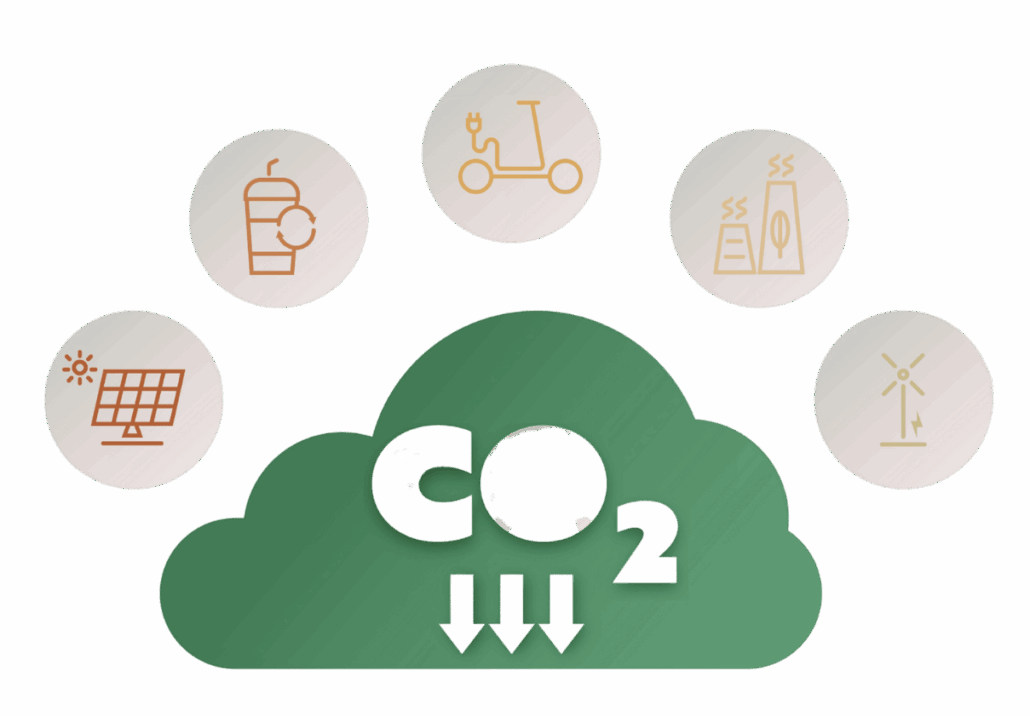
Its objective is to:
- Quantifying emissions,
- Identify the main areas of impact,
- Revealing carbon dependencies,
- Structure a reduction pathway.
The 6 key steps to a corporate carbon footprint
Step 1 — Define the organizational scope
Before conducting any analysis, it is essential to precisely define the scope of the review by determining the sites, subsidiaries, processes, activities, and periods to be analyzed.
Step 2 — Identify the scope of emissions (Scopes 1, 2, and 3)
Once the organization is in place, the challenge is to understand where emissions actually occur.
- Scope 1: Direct emissions: Fuels, processes, fleet.
- Scope 2: indirect energy emissions: Electricity, heat, purchased steam.
- Scope 3: other indirect emissions: Purchasing, service providers, digital technology, real estate, logistics, travel, product use and end of life, capital goods, waste, etc. Scope 3 represents in most cases 70 to 90 % emissions.
Step 3 — Collect data
The quality of the assessment depends above all on the quality of the data collected.
Examples expected:
Purchases (amounts, materials, supplier data), energy (kWh, contracts), transportation (distances, modes), digital (equipment, cloud), waste (tonnages), fixed assets (construction, renovation, etc.).
Best practices: prioritize primary data, document sources, trace assumptions.
Step 4 — Convert data into emissions
Next comes the conversion phase, which transforms the raw material into usable carbon data.
The main sources of emission factors are as follows:
- ADEME Carbon Database,
- International databases (Ecoinvent, etc.),
- Sector-specific bases (transport, digital, etc.),
- Manufacturer data.
The objective of this step is to obtain emissions in kgCO₂e or tCO₂e.
Step 5 — Calculate the carbon footprint
Once the conversions have been completed, the next step is to assemble everything to produce a clear and structured result.
A good carbon footprint calculator should enable you to:
- A breakdown by item,
- A contribution analysis,
- An export compatible with international standards,
- Multi-site and multi-activity coverage,
- Monitoring over time.

Step 6 — Interpret and build the climate strategy
This is the transformation stage: the carbon footprint assessment moves from being a diagnostic tool to a strategic management tool. It provides answers to the question, «How can I reduce my footprint?».
The expected results are the basis of your low-carbon strategy:
Prioritization of transmission stations: identify and target «hot spots» where the reduction will have the greatest impact (often in Scope 3).
Reduction Scenarios & Trajectory: define the quantified path to follow to achieve your goals (for example, –40% by 2030), potentially aligned with the scientific framework SBTi.
Operational roadmap: Translate the overall strategy into concrete and measurable actions for each department (purchasing, logistics, IT, energy).
Monitoring indicators: Establish KPIs (tCO₂e/revenue, tCO₂e/product) to monitor progress and ensure that targets are met.
Diagnosis is just the starting point. Once you've obtained your results, you need to structure a corporate carbon reduction plan to turn your objectives into concrete results.
Ready to take action? Download our 2026 practical guide.
The success of a carbon assessment depends not only on the calculation, but above all on the quality of its preparation.. Discover how to define a suitable scope and anticipate data collection to transform this technical exercise into a genuine strategic management tool..

Tools, resources, and support for conducting a carbon assessment
Possible tools:
- Specialized software,
- Automated platforms,
- Structured spreadsheets,
- Accounting/purchasing/energy connectors.
Official ADEME resources:
- Methodological guides,
- Carbon Base,
- Industry guides,
- BEGES documents.
The role of expertise: ensuring the quality of the balance sheet
A specialized consultant enables you to:
- Define the right scope,
- Making collection more reliable,
- Avoid common mistakes (incomplete scope 3, unjustified exclusions),
- Ensure compliance with existing standards,
- Develop a measurable action plan,
- Align the approach with market and investor expectations.
Take action!
Diagnosis is the first step. Secure your Carbon Footprint® (Scopes 1, 2, 3) and develop a credible reduction strategy with our experts.

Going further in the low-carbon transition: benchmarks and trajectories
After completing its Bilan Carbone® carbon assessment, a company can draw on several frameworks to strengthen its climate action:
- GHG Protocol: for structured reporting recognized by the markets.
- SBTi: to define scientific objectives (voluntary, but expected by certain value chains).
- ACT method! to assess the credibility of the transition plan.
- Net Zero Initiative: to structure the contribution to carbon neutrality.
- Sectoral transition plans (ADEME): for manufacturers facing significant decarbonization challenges.
These tools are not mandatory, but they enhance the clarity and robustness of the approach.
FAQ — Bilan Carbone®: frequently asked questions
What is a carbon footprint assessment?
The Bilan Carbone® is a method developed by ADEME to measure all direct and indirect greenhouse gas emissions from an organization (Scopes 1, 2, and 3). It serves as a basis for defining an emissions reduction strategy.
Is carbon footprint assessment mandatory?
The Carbon Footprint® method is not mandatory.
On the other hand, some organizations must carry out a BEGES (greenhouse gas emissions report) according to the Environmental Code:
- Companies with more than 500 employees in mainland France,
- Companies with more than 250 employees overseas,
- Certain public bodies (every 3 or 4 years).
What is the difference between BEGES and Carbon Footprint?
The BEGES is a targeted regulatory obligation, with a minimum scope defined by law.
The Carbon Footprint® is a voluntary, more comprehensive method that covers all emissions necessary for the company's operations, including Scope 3.
How to conduct a carbon assessment?
A carbon assessment is carried out in six steps:
- Define the scope,
- Identify the scopes,
- Collect data,
- Apply emission factors,
- Calculate your carbon footprint,
- Analyze and develop an action plan.
What data is needed for a carbon footprint assessment?
Depending on the activity, data may include:
- Energy consumption,
- Purchases of goods and services,
- Transportation and logistics,
- Business travel,
- Waste,
- Computer equipment,
- Fixed assets,
- Product life cycle.
Why is Scope 3 so important?
Scope 3 covers all indirect emissions excluding energy (purchases, service providers, freight, travel, fixed assets, digital, product use, etc.). It often represents 70 to 90 % of the total, making it the main driver of reduction.
What tools should be used to calculate a carbon footprint?
Companies use:
- Specialized software,
- Automated platforms,
- The Base Carbone of the’ADEME for emission factors,
- Structured Excel files.
How often should a carbon footprint assessment be repeated?
Ideally, all 1 to 2 years, in order to monitor emissions trends and steer actions.
For organizations subject to BEGES: all 3 or 4 years depending on the type of actor.
What are the next steps after the carbon assessment?
The Carbon Footprint Assessment must result in:
- A reduction strategy,
- A low-carbon trajectory,
- An operational action plan,
- Annual monitoring of emissions,
- Integration into purchasing, logistics, energy, IT, etc.
What is the difference between Carbon Footprint, GHG Protocol, and SBTi?
- Carbon Footprint® exhaustive calculation method used in France.
- GHG Protocol international reporting standard (Scopes 1-2-3).
- SBTi A framework for setting reduction targets in line with 1.5°C.
These reference systems are complementary.
Who must publish their emissions?
The publication concerns:
- Organizations subject to BEGES,
- Certain companies subject to sector-specific regulations,
- Large companies subject to CSRD (but the CSRD does not apply to all companies).
Many companies also voluntarily publish their balance sheets in the interests of transparency.
How long does a carbon assessment take?
Depending on the size of the organization and the quality of the data, the duration varies from 4 to 12 weeks, sometimes more for multi-site or international structures.
How much does a carbon footprint assessment cost?
The cost depends on:
- The size of the company,
- From the perimeter,
- The desired level of detail,
- From the chosen tool,
- External support.
Can you do a carbon footprint assessment yourself?
Yes, but expert support allows you to:
- To avoid methodological errors,
- To obtain a complete Scope 3,
- To structure a credible action plan,
- To meet the requirements of the principals.
How to choose between Carbon Footprint, ISO 14064, GHG Protocol, and SBTi?
It depends on your goals:
- Internal diagnosis → Carbon Footprint
- Reporting structure, particularly internationally → GHG Protocol / ISO 14064
- 1.5°C aligned target → SBTi
- Credibility of the transition plan → ACT method
Mature organizations often combine several frameworks.
How far along are you in your GHG emissions assessment project?
Where do you really stand today?
This maturity test enables you to situate your organization, identify the levers to be activated and better understand the next steps for structuring or reinforcing your CSR and climate strategy.
Duration: 2 minutes