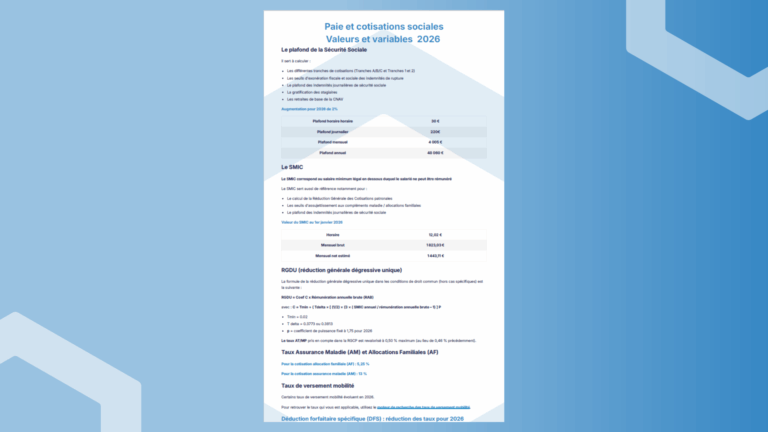
LFSS 2026: key measures to remember (and their impact on employers)
The Social Security Financing Act (LFSS) for 2026, adopted on Tuesday, December 16, 2025, was published at Official Journal of December 31, 2025.
Pending implementing regulations Announced on several measures, here is an analysis of the most significant provisions for employers.
In summary: 6 key measures for 2026 (and beyond)
- Cost of contractual terminations and retirements: +10 points contribution (30% → 40%).
- Overtime: extension of the flat-rate employer deduction (€0.50/hour) to companies ≥ 250 employees.
- Seniors: creation of an “old age penalty” risk” if there is no negotiation or action plan.
- General reduction (RGDU): targeted penalty in sectors where the minimum wage for “unskilled” workers remains below the federal minimum wage.
- Additional birth leave: 1 or 2 months at the employee's discretion (with IJSS), a particularly important issue process & organization.
- Sick leave/workplace accidents and occupational illnesses: stricter supervision (prescription limits, extension limits, and future limitations on temporary disability benefits for work-related injuries and occupational illnesses).
Download the special report:
Social Security Financing Act for 2026
Secure your social media management
Given the complexity of payroll and legislative changes, there is no room for error. Take advantage of a comprehensive assessment of your social security contributions to ensure compliance and recover any overpayments.

FAQ - Social Security Financing Bill 2026
Is the 2026 Social Security Financing Act already “final”?
Yes, it has been adopted, but it still has to pass the Constitutional Council and then be published in the Official Journal.
Do all the measures apply immediately?
No. Several provisions must be the subject of implementing decrees.
What are the two measures that really change the budgetary situation?
- Contract terminations/retirements: increase in employer contribution (30% → 40%).
- Overtime: flat-rate deduction extended to companies with ≥ 250 employees (€0.50/hour).
For which types of companies is it important to calculate the impact of the measures?
- Companies that regularly engage in contractual terminations/retirements (immediate budget impact).
- Companies with ≥ 250 employees (secure the HS settings to capture the gain).
- Companies/groups with ≥ 300 employees with a union section (anticipate the issue of senior citizens).
What is the risk associated with the “senior penalty”?
A financial risk (penalty on pension contributions) if the company subject to the new “experienced employees” negotiations does not negotiate or, in the absence of an agreement, does not have an annual action plan. The specific terms and conditions will be set out in a decree.
The RGDU “minimum wage < SMIC”: does this apply to me?
This is a highly targeted measure: it depends on your collective agreement and your internal salary policy (agreement/DUE). It is not linked to a specific sector but to a specific industry, and is subject to certain criteria.
Additional birth leave: what are the implications for employers?
Mainly organizational (longer absences, replacements, scheduling). The cost will also depend on your agreements (employer supplement) and compensation rules (decree).
What is the best way to plan ahead without getting overwhelmed?
Perform a three-part flash diagnosis of HR/Payroll/DSN:
- Budget (RC/retirement, HS),
- Compliance (seniors, RGDU),
- Process (birth leave, sick leave/temporary disability benefits/workplace accidents).