Smart Grids, Buildings, Industry, Telecoms: the concrete contributions of AI to the energy transition
AI at the service of a measurable low-carbon transition
Artificial intelligence (AI) can be a powerful lever for decarbonization—provided that its actual energy impact is controlled. This white paper explores the concrete applications of AI in energy systems, buildings, industry, and digital networks, and shows how it contributes to a effective sobriety : optimization of smart grids, low-carbon management, predictive maintenance, and digital energy twins.
Why download this white paper?
This document—both technical and operational—provides a comprehensive overview of AI applications that promote energy efficiency and carbon in physical systems:
- Energy and smart grids Smart Grids, microgrids, carbon-aware control, flow orchestration, and low-carbon management
- Cognitive buildings and cities : Resident-centered HEMS, active buildings, smart HVAC control, adaptive comfort, and multi-purpose optimization
- Industry and processes : digital twins energy, predictive maintenance, cognitive factory systems, and real-time monitoring
- Digital networks and IoT : Eco-efficient cloud, edge, and IoT/6G, distributed architectures, and infrastructure efficiency
Download your free copy now
What you will discover there
This white paper is based on recent scientific publications in order to introduce you to:
- A structured state of the art on the use of AI in smart grids, active buildings, industrial processes, telecoms, and IoT;
- Of use case : Smart HVAC, eco-efficient Cloud and Edge, cognitive cities;
- Tips to help you structure a responsible innovation roadmap, based on the principles of CSR and sustainable development.
- Opportunities for public funding available to boost your projects.
Who is this white paper for?
This white paper is aimed at R&D, Innovation, and Sustainability departmentsas well as energy, digital, and production managers wishing to integrate artificial intelligence into an approach to responsible energy and digital transition. It will also be of interest to companies, local authorities, and industrial players committed to decarbonizing their activities and improving the energy performance of their systems.
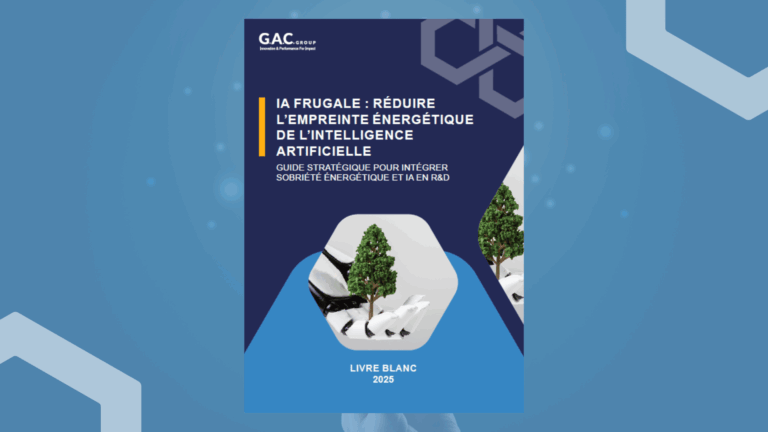
In addition, the Volume 1: «Frugal AI: reducing the energy footprint of artificial intelligence» explores digital sobriety in terms of AI models and infrastructure, and is the technical counterpart to this second volume devoted to sobriety through AI.
Did you find this summary useful? Find out about our other studies on major industrial issues with impact.
Newsletter
Receive all our expert news by e-mail.
Subscribe to our newsletter.